
·
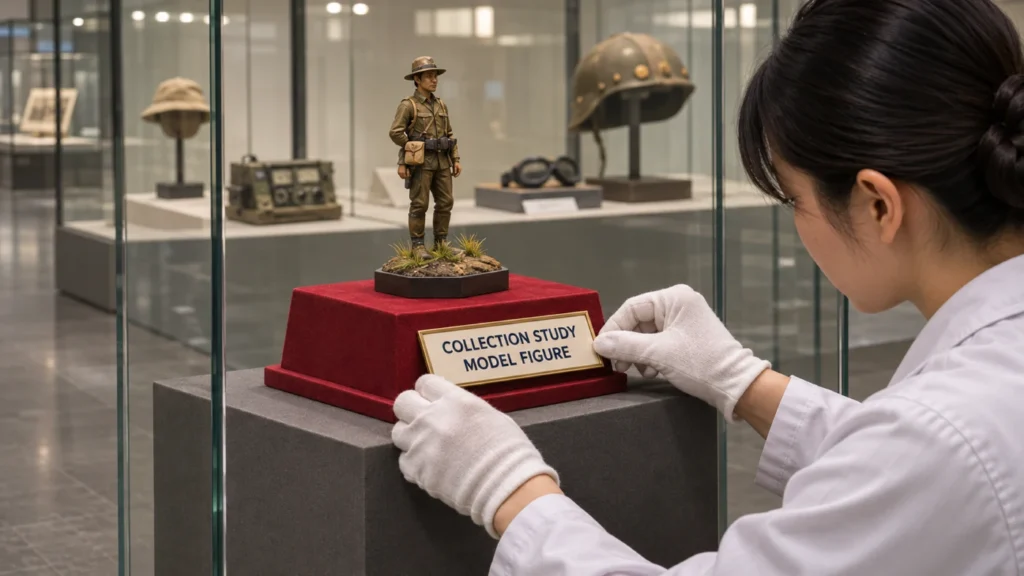
Long before any items actually suffer damage they can cease to have any real meaning. A single missing packaging insert, a mystery edition, a label that cannot be verified – in time all of these things could be rendered completely unknown to future generations. All of a display full of items is rendered meaningless by poor records of said items, packaging, history etc. of said items of the civilian pastime in question. The best way to make such records of items from your hobby is to 1) observe said items, 2) prove that you actually observed said items in the first place and 3) write down only what you can verify from the afore-mentioned observations.
Start with the received object, not the story around it
For this hypothetical exhibit we are going to take a look at putting some of our own personal items from our respective hobby-based collections in a small community-based exhibit. The scenario is that a collector has been given a model figure and its outer carton, packaging inserts, etc., by a friend. The figure is an older Japanese release and the collector has no receipt for it; the friend who gave it to him informed him that it was an older release, but could not say exactly what.
Record how the packaging arrived with the model figure (e.g. a small outer box). Write a note to describe the outside packaging in simple terms that would be understandable by a layman. Also write a note to record how the items arrived inside the outside packaging in simple terms that would be understandable by a layman. Take photos to support the notes for both the outside packaging and the inside packaging.
Packing box and packaging inserts are not evidence of history of item. Item's packaging can be changed, mixed up with other editions of item, lost from item. The best evidence of a neat box and its contents are the photos of them in good condition before they are displayed. The packaging is not absolute proof of history of item.
Edition identification needs restraint
This gives evidence for a number of reference numbers. In the case shown here, there is reference number MNCH-12345 on the box front. In addition, there are reference numbers M00-12345-Model and MNCH-SP-12345 on the box inner. If any of these are later confirmed in other documentary evidence then the corresponding section of the collection note should be revised accordingly to reflect the new evidence.
A publication date is the date a printed booklet was published. An exhibition date is the date an object or exhibit was displayed. A model's release date is the date a model was released for sale by the manufacturer. If you cannot verify a date enter 'date not established' or leave it blank. A visual impression is not evidence of a time line.
In reference to illustrated publications for identification purposes of figures, such as articles, catalog drafts, or display guides, always note these as illustrations within such publications. These are only used to better explain a subject and in no way serve as proof of a product's identity, release, original packaging, etc., of a model figure in the possession of a civilian collector.
Condition reporting begins with symptoms
When you have observed any wear on the object for display, write down all the symptoms of any problems and do not make any assumptions about their causes. For example, a crushed corner, a small separation of the upper and lower halves of the right hand side of the front of the box, some surface dust, a loose insert and an area of the model box's surface that has a different color to the rest of the surface and appears to be slightly raised all need to be recorded. Are they getting any worse? Try to remember when you first noticed them and record this too. Take photographs of all the symptoms and make a note of whether they are changing and when you first noticed them.
For each of the above symptoms determine if they are changing or not and start to record the date that you first notice them. These symptoms could indicate a problem, either with the environment that the collectible has been stored in or with the collectible itself. Include photographs of the symptoms and make sure that there is sufficient background in the images for later to include a scale in order to determine the size of any damage.
Be aware that active-looking stains or others that appear to be spreading could be dangerous for other items on display. Loosely attached packaging that appears to be brittle could also fall apart whilst on display. Items in the collector's collection that are of this nature should be separated from other items and great care taken not to handle them further. In due course seek the advice of a conservator or museum.
No method of conservation is better than another as long as they are all to some extent reversible. As far as possible therefore the method of conservation to be used on the illustrated model figures should be to clean them in a stable environment and then support them in such a way that no part of the model is subject to stress. Chemical treatment, local repair and aggressive cleaning are all methods of conservation that are best done by a professional and are not really suitable for the casual hobbyist collector.
Provenance is a chain of modest records
Even the most straightforward of hobbyist civilian collectibles does not need to be proven with a 'big story' about where it came from. In fact simple notes recording how you received an object from another person, how you got the packaging for an item, how you first opened the packaging of an item and viewed the collectible(s) within and how you subsequently went on to display the item or items will be more than sufficient for most people's needs when considering the provenance of a collectible. Also remember to try and keep apart the information that you have been given by others as opposed to what you have found out by your own means and investigations.
A list of all items of paper ever added to the file of an object should include a collection number, date of intake, full description of object and packaging, all dimensions taken (of object and/or packaging), filenaming of all images of the object, a full history of all changes to the notes on the object (new information incorporated, mistakes corrected, misunderstandings resolved). All paper ever added to the file of an object should be stored in the file with the object. Notes on objects and their captions must be copied verbatim as original documents. They will then be revised and the original notes/captions retained and clearly distinguished from revised notes/captions.
A source for documentary evidence is itself usually incomplete. A catalog may not list all packaging for a model, a photograph shows only one side of an object, and a museum display may identify a series but fail to list all models in that series. Such limitations must be recorded by the collector and he or she must not overclaim in the basis for notes entered for that collectible based on such source or evidence.
Display, permissions, and the public label
It is important to establish who holds the copyright for the images of the works in your collection before taking photographs for use in exhibitions or in articles in club magazines. You also need to establish whether any part of a work has been supplied by another person. You require permission from the copyright holder to take photographs of a work for purposes of reproduction. Permission to reproduce an object does not imply that you may also reproduce the packaging, notes, etc. that you received with that object.
This would form part of a written label for the display of the object(s) in your collection, helping to answer questions that other people may have about objects of interest within your hobby-based collection. For example: Japanese model figure, displayed in boxed form. The illustration has been used within the identification context of the object only. The packaging was received by the collector in the recorded condition only.
Labelling for public display of objects in your collection should serve to identify of interest objects in your collection and to inform the public of what you have of interest. A written label should state the basis of identification of an object and whether or not certain items of evidence have been confirmed. Reference should be made to relevant documentation which supports written statements in labels. Display items must not be confused with protective gear currently in use and adequate warning must be given of any hazards affecting the public in your display.
A collection of objects from a hobby, pastime or leisure activity of several centuries length, encompasses more than good-looking objects. It also encompasses all sorts of other matters, including: other means by which objects from that hobby etc. were packaged up; the Provenance of those same objects; and Recording the Condition of those same objects from the time that they were collected.
Related articles
How to Document a Collectible Model
Create useful records for a collectible model using consistent photos, labels and provenance notes.
Read More