
·
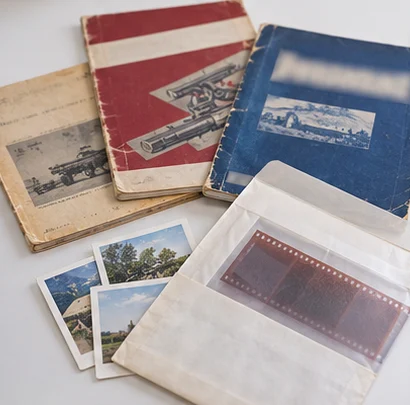
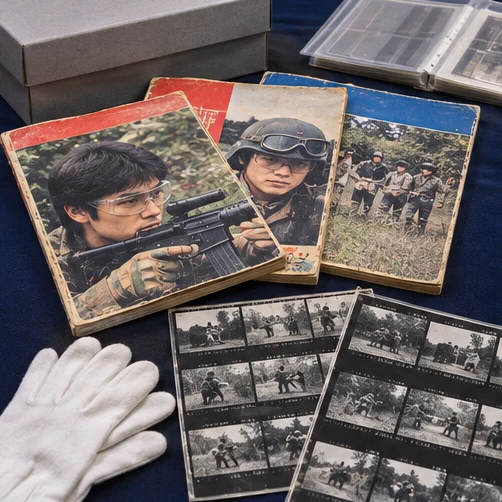
When viewing these Japanese hobby publications as collectibles, museums and researchers can gain insight to the space of civilian recreational culture in the past. As fragile objects they must be recorded and documented in such a manner that as much information as possible can be extracted from them and that all information that is uncertain (date, images, translations) can be saved for later reference. Record what the publication actually says, make a distinction between observation and interpretation and save all clues for the time when they can be used to solve the question in question.
Read the Object as a Publication
The catalog should first be viewed as a publication, a printed work of information. In recording a printed source such as this, the title of the catalog should be written down exactly as it appears on the cover in all languages. The supposed publisher or sponsors of the catalog should be noted as well as the dimensions and pagination of the whole. If the cover is missing then this should be noted and the catalog described (e.g. 'Untitled Japanese Catalog', a 'Japanese Catalog', etc.).
Look at the catalog in layers. First, look at the cover. The title and edition there will often differ from the short title in the contents page. Then, verify the pagination. Are there any missing leaves? Are there any inserts? Is it a later binding? The advertisements in the catalog often were printed at the same time as the rest of the publication, even though they may give a sense of a later time when the publication was distributed.
It is also important to note the absence of a colophon for this catalog. A Japanese publication's colophon is typically the section where information about a work's publication can be located. All such information discovered in a catalog's colophon should be recorded and annotated as unknown or as having been read provisionally. The end matter of a catalog should be photographed or scanned in its entirety and all the information from it transcribed and annotated and recorded in the appropriate fields.
Edition Clues Need More Than One Date
Information about the dates of the information in a catalog needs to be recorded carefully and distinguished from the dates of the publication, of an exhibition etc. Information such as the date of a picture in a catalog does not have to be the same as the date of other information in that same catalog. A reprinted page can contain old advertising material with dates which are different from the printing date of the reprinted cover etc. All information about the dates of the information in a catalog must be recorded with utmost care.
For the positive edition clues (date, revised contents, ad changes, publisher/printer name changes, new cover art, new colophon) note if they are positive (i.e. they are there) or negative (i.e. they are missing and this is mentioned in the body of the catalog). Do not use these edition clues to try to determine the number of copies of a publication that were printed or distributed. They will simply describe the publication(s) that were printed in their completed form.
You may find that reprints of the original work are published long after in the same design, even as a facsimile, complete with all original errors. Alternatively there may be obvious differences, for example a printed notice included in a supplementary sheet of paper, or a change in paper thickness etc. The colophon may even have been moved from its original location. So when comparing different editions of a work it is the dates printed in the colophon that need to be compared, not the publication dates.
A Hypothetical Ambiguous Catalog
Consider an example catalog: a museum has acquired a catalogue for display models for civilian recreation by a Japanese company from about 1940. The cover has a Japanese title printed on it with the printed date visible. As described above, the contents page has a different title. The publication paginates from p. 3. There are 'loose advertising inserts' possibly used as inserts in the publication and a 'loose sheet of paper' of different paper tone to the rest of the publication. The researcher has looked at a scan of the material but the scan does not include the end of the publication.
Notice that there is a difference between your first record for an object and your first interpretation of that object's publication history. So for example, Cover reads '[Title printed in Japanese]' with printed date visible on cover. The publication presumably paginates from p. 3. There is a 'loose advertising insert' possibly used as an insert in this publication. The 'loose sheet of paper' has different paper tone to rest of publication. The scanned material does not include the colophon. And then your interpretation of that could be: Publication possibly an incomplete copy of a publication. 'Loose advertising insert' possibly used as an insert in this publication. Publication cannot be confirmed to be an edition of anything yet. Do not confuse these for printed conclusions on the object that you can distribute to others.
A useful thing to do is to create an 'evidence log' of the scans. The evidence log should consist of a list of the scans which have been made of the material, with file names for each which indicate the page that has been scanned (e.g. front cover, p.5, back cover). Also useful to note about each scan are whether it is a photograph of the material or a digital scan, and whether the scan has been cropped or any of the contrast adjusted in order to make the image better to view on screen. Also it is useful to note whether the edges of the pages have been scanned and whether there are any folds in the publication.
For the 'loose sheet of paper' treat this as a separate entry to the catalog entry for the 'printed material'. Record the dimensions of this sheet in comparison to the printed material; any readable text from the sheet; note the paper type and any other marks on the sheet that link to the rest of the volume. (For now record this as an 'associated insert').
Translation, Advertising, and the Missing Context
The work that goes into making a good English catalog entry for Japanese material should also be recorded. In addition to the original language Japanese text, a very literal translation of the text and your edited summary should be recorded in separate fields. Even the best edited English summary can conceal important qualifications, distinctions between categories, and references to specific editions. Thus it is best to keep the working translation separate from your edited summary and provide the latter in a separate field as well.
Advertising can also provide problems for the cataloger of printed materials. An advertisement published in a work does not necessarily mean that the goods, services, information, etc. advertised by that advertisement were available at the same time in the same form to purchase from or to read about by the same group of people who read the work as a whole.
Preserve the Record Before the Paper Fails
Any damage to printed material is most often detected with the naked eye. Thus a simple check list can note: binding, edges, inserts, scanned pages (and number of copies made of said pages). Note any unusual wear, but do not open up folded pages, attempt to remove fasteners holding a cover, or clean printed surfaces, etc. in order to preserve the printed material for future research. Note any unusual wear in the printed material as noted above.
Make sure your own file naming follows a stable convention (using the publication id followed by the page number for example). Record the short condition notes against each image record. Also, make sure to include multiple images of items of special note such as the colophon, front cover, inserted material, etc. as well as the last page or so of the publication that was scanned in only part.
A good question to end a catalog record with is one that other people can answer. In other words, for questions about the publication history of an object, use the same evidence that you used to answer questions about the object itself, and state your answers provisionally.
Build a Citation That Can Be Rechecked
Create a short citation for reference. Create a complete list of all sources referenced. (Note that complete citations should be created first and then cross-referenced with the written description to check for accuracy.) Provide the full publication title as it appeared on the publication, and the apparent publisher. Provide any edition information and the printed publication date. Provide the numbers of the pages that were referenced in the written description, and comment on any problems with the condition of the publication referenced. State where the publication is located. State whether the publication was viewed as a printed copy or as a scan, and whether the scan was complete.
Their value lies in the fact that, as further information is found about the work, the written notes can be updated and even corrected should more complete copies of the work under consideration come to light. For example, another copy of the work here described may have a complete colophon; a clearer scan of the same page of text may read a previously unknown character; an apparently inserted item or supplement may actually be from a different edition of the work.
Related articles
The History of Airsoft in Japan
Read the history of Japanese airsoft through hobby catalogs, collecting and organized recreation.
Read More